
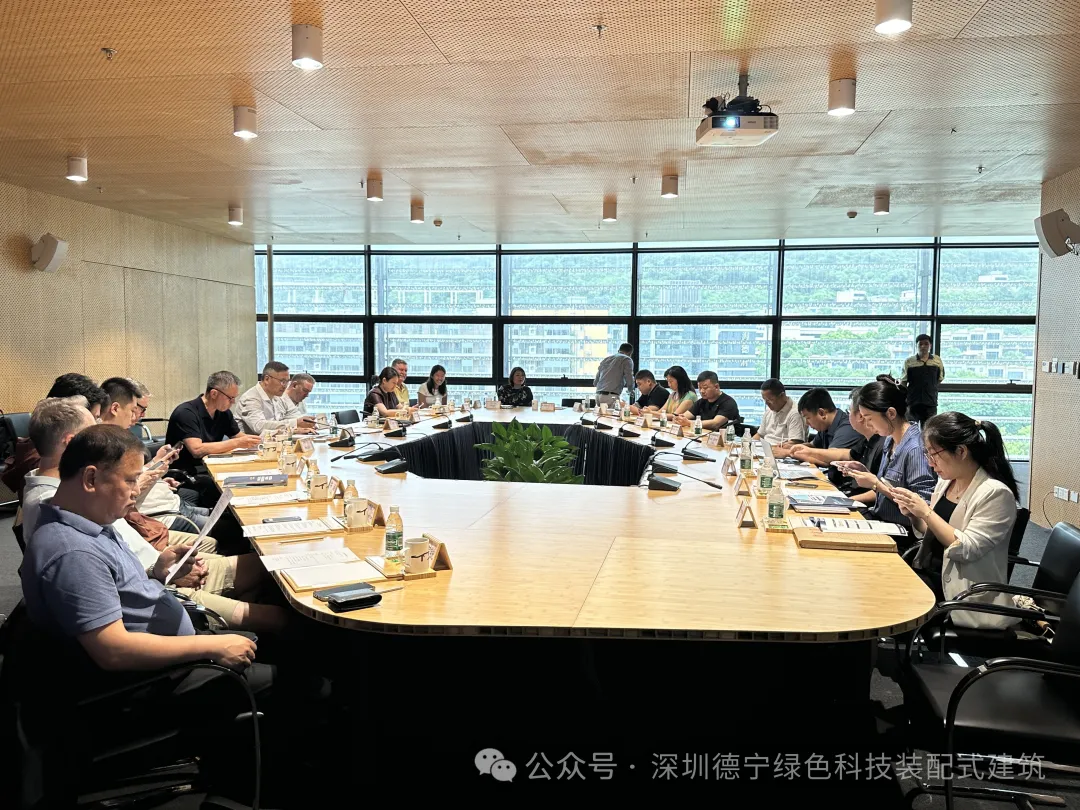
In September 2024, Frank Xu, Deputy General Manager of New Zealand Shundi Group and President of the New Zealand Chinese Construction Industry Association (NZCCIA), led a delegation of more than 20 local construction industry entrepreneurs to visit Biosphere No.3 in Shenzhen. They conducted in-depth exchanges with multiple Shenzhen-based enterprises including Dening, to jointly explore innovative solutions to address issues such as the housing shortage and high construction costs in New Zealand.
During the exchanges, President Frank Xu pointed out that the New Zealand construction industry has faced numerous challenges in recent years, including the rising cost of construction materials, delays in approval processes, and shortages of land resources. To tackle these challenges, the New Zealand government has introduced a series of key initiatives and policies aimed at simplifying approval procedures, reducing the cost of construction materials, and promoting the sustainable development of the industry.
In March last year, Chris Penk, New Zealand’s Minister for Building and Construction, elaborated on the New Zealand government’s plans and goals for the future of the construction industry in a speech delivered to the New Zealand Institute of Building Surveyors. He also mentioned that starting from April, the public would be able to check the processing progress of building consents and code compliance certificates in real time. Penk emphasized that the construction industry plays a vital role in New Zealand’s economy, contributing approximately 6% to the country’s total GDP and employing over several hundred thousand people, accounting for around 10% of the total labor force. Almost every New Zealander has a stake in the construction industry, making it irreplaceable for national economic recovery and sustainable development.
Furthermore, the New Zealand government announced a series of major policy adjustments to promote the openness and innovation of the construction industry. On April 4th last year, New Zealand Prime Minister Christopher Luxon, together with Chris Penk, jointly announced that New Zealand would eliminate border barriers to overseas construction products and introduce three key amendments to the Building Act:
To recognize construction product standards from trusted overseas jurisdictions, thereby avoiding the need for designers or builders to conduct redundant standard verifications;
To require building consent authorities to permit the use of products that meet specific overseas standards, provided that these standards are equivalent to or higher than New Zealand’s current standards;
To approve the use of construction products certified by overseas schemes, such as Australia’s WaterMark Program.
Once these products are approved, the New Zealand market will immediately gain access to as many as 200,000 new construction product options.

The relaxation of these policies has facilitated the entry of high-quality Chinese construction products into the New Zealand market. This not only helps reduce the cost of construction materials but also brings more diversified product options to the local market.
Against this backdrop, Dening’s green prefabricated housing has introduced new ideas for the development of sustainable architecture in New Zealand. Its products are made of environmentally friendly and energy-efficient materials, with over 90% prefabricated in factories and assembled on-site in a modular manner. This not only enables fast installation and labor savings but also effectively reduces pollution at construction sites. It provides New Zealand residents with a more cost-effective and eco-friendly housing solution, opening up new possibilities for the local implementation of sustainable architecture.